
Your Startup’s Secret Weapon for Online Visibility
Read all our future blogs on Elgorythm.in
For any burgeoning enterprise, establishing a strong online presence is not merely an option; it is a fundamental necessity. In this digital age, Search Engine Optimization (SEO) stands as a pivotal strategy, offering a distinct advantage over traditional marketing avenues. Unlike Pay-Per-Click (PPC) campaigns, which cease to deliver traffic the moment the advertising budget is depleted 1, organic search, once cultivated, provides a continuous stream of visitors without direct per-click expenditure. This inherent cost-effectiveness makes SEO an invaluable asset for new businesses operating with constrained marketing budgets.2
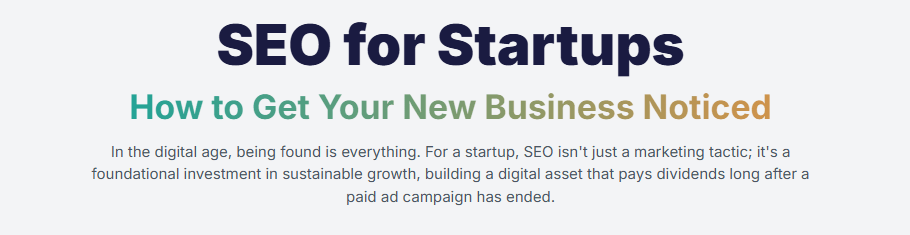
The benefits of SEO extend far beyond immediate traffic generation, contributing significantly to a brand’s long-term viability and market standing. Consistent high rankings on Search Engine Results Pages (SERPs) convey a powerful message to users: that search engines, particularly Google, deem the website and its content trustworthy and authoritative.2 This cultivated trust directly translates into enhanced click-through rates and, crucially, a higher volume of qualified leads and subsequent sales.2 While SEO results typically manifest over a period of 4 to 6 months, or potentially longer depending on the specific niche and competitive landscape 5, the return on investment (ROI) it yields is consistently remarkable, often catalyzing transformative business growth.2
From a strategic perspective, SEO for a startup should be viewed not as a mere tactical expenditure but as a foundational investment. While paid advertising can offer immediate validation and quick wins, SEO systematically builds a durable digital asset—comprising domain authority and organic visibility—that appreciates in value over time. This approach progressively diminishes a business’s reliance on costly paid channels as it scales. Such a focus aligns seamlessly with the “lean startup” methodology 7, emphasizing efficient, sustainable growth by integrating SEO as a core component of the business strategy from its inception. It is about establishing a valuable, trust-generating online footprint that compounds over time, rather than simply driving transient traffic.
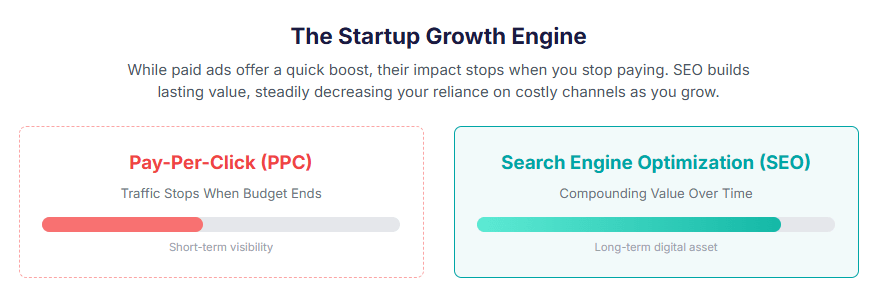
Understanding the Startup SEO Landscape: Challenges & Opportunities
New businesses entering the digital arena frequently encounter a unique set of obstacles that can impede their online visibility. A primary concern is often the inherent budget and resource limitations, which make it challenging to allocate substantial funds towards comprehensive SEO initiatives.3 Furthermore, startups must contend with the formidable presence of established brands that possess considerable online authority and extensive backlink profiles.3 Technical SEO, encompassing aspects like site speed and indexing, can also present daunting complexities for new ventures, particularly those lacking dedicated in-house technical teams.3 The consistent production of high-quality content and the acquisition of valuable backlinks represent additional common struggles for nascent businesses.3
Despite these formidable hurdles, startups inherently possess unique advantages that can be strategically leveraged for SEO success. Their inherent agility allows for swift iteration and adaptation to evolving SEO trends and algorithm updates, a flexibility often absent in larger, more entrenched organizations.10 Moreover, a focused niche often enables startups to target specific, less competitive long-tail keywords, thereby attracting users with higher purchase intent.7 New businesses can also build credibility from the ground up by prioritizing an exceptional user experience, developing valuable content that directly addresses customer pain points, and actively fostering engagement with their audience.4
The resource constraints faced by startups, rather than being a disadvantage, can actually compel a more intelligent and focused SEO strategy. Without the financial capacity to compete with industry giants for generic, high-volume keywords 3, new businesses are naturally guided towards long-tail keywords 12 and highly specialized content. These more specific keywords, while exhibiting lower individual search volumes, attract users who demonstrate a significantly higher intent to convert.13 This results in superior conversion rates.2 This strategic pivot, often summarized as “low volume + a problem you solve = winning” 10, transforms a perceived limitation into a potent competitive advantage. It fosters a focus on delivering specific value, which ultimately yields higher quality leads and a more favorable return on investment, rather than merely inflating traffic numbers.
Mastering Keyword Strategy: Get Found by the Right People
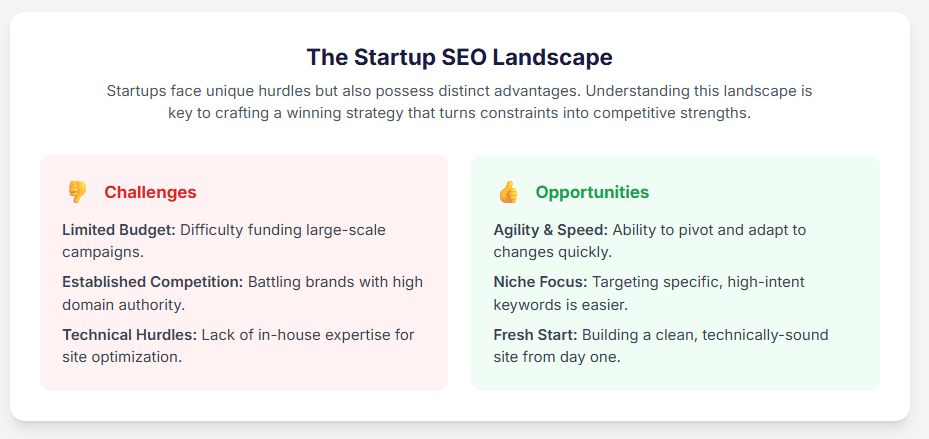
For startups, a nuanced approach to keyword strategy is paramount for achieving online visibility. While broad, high-volume terms such as “startup” (which boasts a global search volume of 1,000,000) 7 might seem appealing, directly competing for such keywords is often an unfeasible and “losing game” for new businesses.12 Instead, the focus should shift to
Long-tail keywords.
These are specific phrases, typically three or more words in length, that convey a heightened level of user intent and focus.13 Long-tail keywords are inherently less competitive, making them significantly easier for new websites to rank for, and they consistently attract highly qualified traffic.13 For instance, optimizing for “best running shoes for flat feet” is far more effective than attempting to rank for the generic term “shoes”.13
To effectively uncover these valuable, high-intent keywords, startups should leverage a suite of powerful keyword research tools. Google Keyword Planner, a free resource, along with industry-leading platforms like SEMrush and Ahrefs, are indispensable for identifying keyword suggestions, analyzing search volume data, and assessing competitive difficulty.22
Google Search Console provides direct insights into the keywords for which a website is already ranking and any indexing issues.22 Tools such as
AnswerThePublic and Ubersuggest are particularly useful for discovering question-based long-tail keywords and related search queries that reflect natural user language.18 Furthermore, a thorough analysis of competitor keywords can reveal untapped opportunities and successful strategies within a specific niche.11
A particularly potent subset of long-tail keywords for startups are those that address “pain points.” These are specific search terms that articulate a user’s immediate problem, challenge, or unmet need.14 By strategically targeting these pain point keywords, startups can attract an audience that is already “problem-aware” or “decision-ready”.14 This leads to a significantly higher conversion potential.26 Methods for identifying these crucial terms include conducting detailed audience interviews, meticulously scrutinizing competitor reviews, analyzing “People Also Ask” sections in search results, and reviewing customer service tickets for recurring issues.14 This strategy allows startups to bypass direct competition with established brands on broad, generic terms. Instead, it enables them to position their offerings as direct solutions to specific, urgent problems, converting searchers into customers more efficiently. This approach underscores that SEO for startups is not merely about achieving rankings; it is about strategically aligning content with the user’s journey and their specific needs at each stage, thereby transforming search visibility into tangible business growth.
Here is a table illustrating high-intent long-tail keyword examples for various startup categories:
| Category/Industry (Example) | Broad Keyword (High Volume, High Competition) | High-Intent Long-Tail Keyword (Lower Volume, Higher Conversion) | User Intent |
| SaaS (Software) | CRM software | CRM software for real estate teams | Transactional |
| E-commerce (Apparel) | Shoes | Best running shoes for flat feet | Transactional |
| Local Service (Plumbing) | Plumbing | Emergency plumber near me 24/7 | Transactional |
| Health Tech | Mental health app | Affordable online therapy for anxiety | Transactional |
| EdTech | Online learning platform | Best coding bootcamps for beginners in Delhi | Informational/Transactional |
| Fintech | Digital banking | How to choose a secure mobile banking app for small business | Informational/Transactional |
Crafting Content That Ranks: On-Page SEO & NLP Optimization
The cornerstone of effective SEO is the creation of unique, valuable, and comprehensive content. Search engines, particularly Google, prioritize content that genuinely assists users by providing thorough and authoritative answers to their queries.4 For startups, this translates into a mandate to develop original, informative, and engaging content that directly addresses the target audience’s questions and pain points.4 The objective is not merely to achieve a certain word count, but to demonstrate deep topical authority and expertise.27
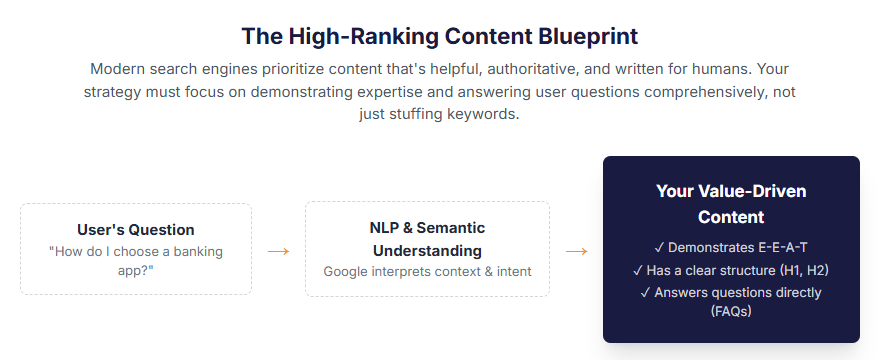
Beyond the quality of the content itself, its structure plays a critical role in both user experience and search engine comprehension. A clear, logical organization is vital for both human readers and search engine crawlers. Utilizing HTML headings (H1 for the main title, H2s for primary sections, and H3s for subsections) effectively organizes content into a digestible hierarchy.4 Breaking up extensive text into shorter paragraphs, incorporating bullet points, and using lists significantly enhances readability and scannability.4 Employing an “inverted pyramid” structure, where the most crucial information is presented at the outset, is also highly effective for engaging users and conveying core messages promptly.30
Modern search engines, powered by sophisticated Natural Language Processing (NLP) systems like Google’s BERT 30, have evolved to understand the context and underlying meaning of content far beyond simple keyword matching.29 To optimize for NLP, content should be written naturally, as if engaging in a conversation with a person, rather than resorting to “keyword-ese” or artificial keyword stuffing.7 A key aspect of this involves focusing on
Semantic keywords
terms that are conceptually related to the main topic, even if not direct synonyms.24 Directly answering specific user queries, particularly within Frequently Asked Questions (FAQs) or Q&A formats, can significantly increase the likelihood of content appearing in valuable featured snippets on SERPs.27
Furthermore, entity recognition is fundamental to semantic SEO. It involves clearly communicating the subject matter and its associated entities—such as people, places, organizations, or abstract concepts—to search engines.32 Implementing
structured data (often referred to as Schema markup) explicitly informs Google about the relationships between different entities on a page.6 This structured information helps search engines better interpret content, potentially leading to richer, more informative search results.
Meta titles, meta descriptions, and image alt text serve as critical on-page elements that form a website’s initial impression on the SERP. Crafting compelling meta titles and descriptions that naturally incorporate primary keywords and accurately summarize the page’s content can significantly improve click-through rates.4 For images, utilizing descriptive alt text that includes relevant keywords not only enhances accessibility but also aids search engines in understanding the visual content.4
The evolution of search engine algorithms signifies a profound shift from the outdated practice of keyword stuffing to a sophisticated emphasis on contextual relevance and entity understanding. Google’s advanced algorithms are exemplified by BERT 30. These algorithms are designed to comprehend the meaning and context of content. They focus on understanding rather than simply detecting the presence of specific keywords. Consequently, the mere repetition of keywords is not only ineffective but can lead to penalties.7 The contemporary focus is on creating content that thoroughly covers a topic, provides comprehensive answers to user questions, and demonstrates Expertise, Experience, Authoritativeness, and Trustworthiness (E-E-A-T).4 This is achieved by naturally integrating semantically related terms and entities.29 This implies that a startup’s content strategy must prioritize delivering genuine user value and employing natural language over attempting to manipulate search rankings through technical keyword tactics. High-quality, well-structured, and contextually rich content that deeply addresses user intent will inherently perform better in modern search environments, as it aligns directly with how Google processes and ranks information.
Building Authority: Off-Page SEO & Local Visibility
Beyond on-page optimizations, establishing a strong online authority is crucial for startup SEO, with backlinks playing a pivotal role. Backlinks, which are links from other reputable websites pointing to your own, serve as a powerful signal of authority and trustworthiness to search engines.2 For nascent websites, acquiring high-quality backlinks can be one of the most challenging aspects of SEO.3 Nevertheless, they are indispensable for enhancing domain authority and improving overall search rankings.5
Startups can implement several actionable link-building strategies to build their authority:
- Guest Blogging: Contributing high-quality articles to relevant industry websites can secure valuable backlinks. It is important to target sites known for their editorial standards and ensure that any links are naturally integrated within the content.21
- Digital PR: Engaging in strategic digital public relations efforts can generate media coverage and brand mentions, which often naturally translate into backlinks.21
- Converting Unlinked Mentions: Proactively monitoring for instances where your brand or product is mentioned online without a corresponding hyperlink provides an opportunity to reach out to the site owner and request a clickable link.21
- Broken Link Building: Identifying broken links on reputable websites within your niche and proposing your relevant content as a replacement can be an effective way to acquire new backlinks.21
- Creating Linkable Assets: Developing truly valuable, comprehensive content such as in-depth guides, original research, or compelling infographics can naturally attract links from other websites over time.21
- Collaboration and Networking: Building genuine relationships with other businesses, industry influencers, and peers within your niche can lead to organic backlink opportunities and content collaborations.21
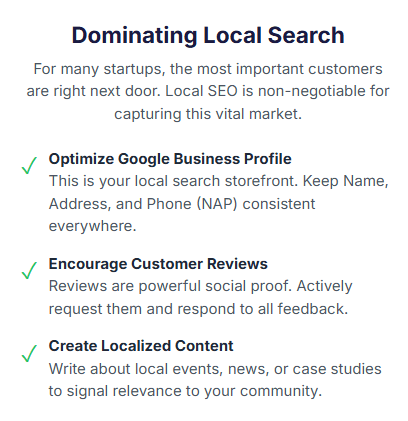
For startups with a physical location or those serving a specific geographic area, Local SEO is paramount for getting noticed in their immediate vicinity.3 Key local SEO essentials include:
- Optimizing Google Business Profile (GBP): This is arguably the most effective tool for appearing in local search results and Google Maps.4 It is crucial to ensure that all business information, including Name, Address, and Phone number (NAP), is consistent and accurate across all online platforms.13 High-quality photos and detailed operating hours should also be included.28
- Local Citations and Reviews: Building local citations by listing the business in various online directories (e.g., Facebook, Yelp, Bing Places) enhances online visibility.13 Actively encouraging and promptly responding to customer reviews is also vital, as reviews significantly build credibility and influence purchasing decisions.2
- Localized Content: Creating content that caters to local interests, events, and news, while naturally incorporating location-specific keywords, can greatly improve local search visibility.13
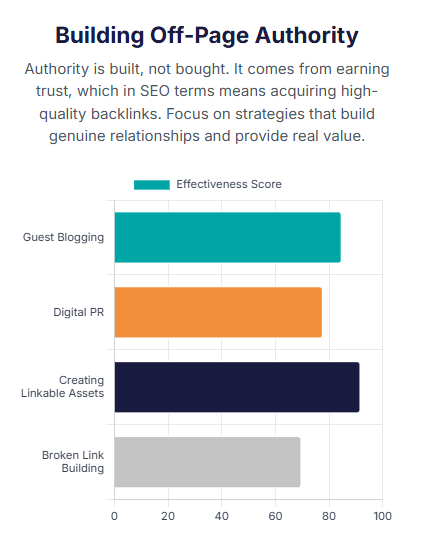
For resource-constrained startups, prioritizing specific link-building strategies can transform a perceived weakness into a strategic advantage. Instead of pursuing expensive, large-scale link acquisition campaigns typically employed by larger corporations, new businesses should focus on low-cost or free methods that leverage existing assets and relationships. This includes creating “shoulder niche” content—content not directly about the product but highly relevant to the target audience’s broader interests, making it more shareable and link-worthy.24 Leveraging existing networks by asking friends, relatives, employees, and business partners for relevant links can provide an initial boost.37 Focusing on local link building, by engaging with local businesses, organizations, and community websites, is often less competitive and highly effective for local visibility.25 Additionally, developing truly valuable, comprehensive content (linkable assets) that naturally attracts links over time is a sustainable approach.21 This strategic emphasis shifts from aggressive, quantity-driven link building to organic, relationship-based, and value-driven approaches that are more sustainable and impactful for new domains.
Technical SEO Checklist: Ensuring Your Site is Search-Engine Friendly
A technically sound website is the bedrock of any successful SEO strategy, particularly for startups looking to establish a robust online presence.
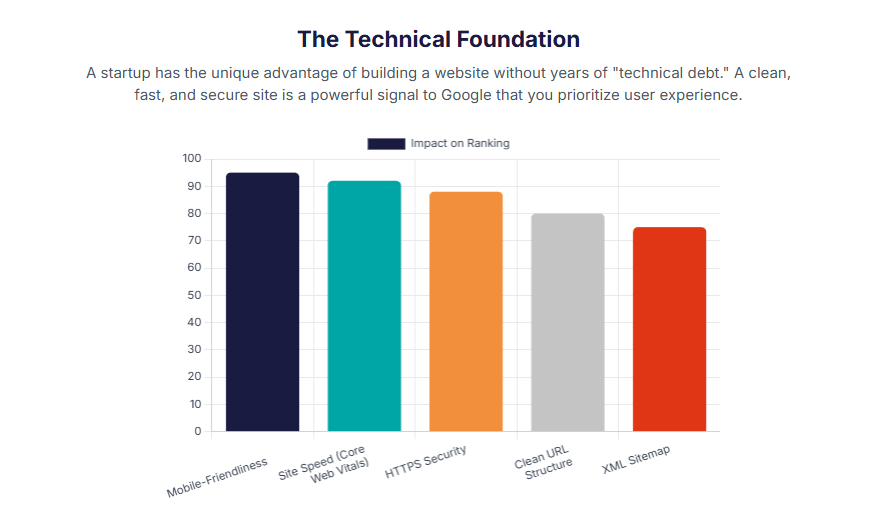
Site Speed and Mobile-Friendliness: Google places significant emphasis on websites that load quickly and are fully optimized for mobile devices, as these factors directly impact user experience.8 Slow-loading pages can lead to high bounce rates and negatively affect search rankings.9 To optimize site speed, it is recommended to compress images, choosing efficient formats like JPEG over PNG, and to compress HTML, CSS, and JavaScript files.24 Implementing a Content Delivery Network (CDN) can also significantly reduce loading times by serving content from servers geographically closer to the user.35 Ensuring that the website is responsive and adapts seamlessly across all devices is also critical for mobile-friendliness.13
Sitemaps and robots.txt: An XML sitemap serves as a comprehensive map of your website, helping search engines understand its structure and discover all pages intended for indexing.6 Submitting this sitemap through Google Search Console is a crucial step.6 Conversely, a
robots.txt file provides instructions to search engine bots, indicating which pages or sections of the site should not be crawled. This helps manage the crawl budget and prevents the indexing of duplicate or private content.13
Fixing Common Technical Issues: Regular audits of the website are essential to identify and rectify common technical issues that can impede performance. These include broken internal and external links 8, duplicate content 13, and crawl errors that prevent search engines from accessing pages.6 Ensuring proper indexing of all relevant pages and connecting “orphan pages” (pages without any internal links pointing to them) are also vital for comprehensive discoverability.9
Structured Data (Schema Markup): Implementing structured data, commonly known as Schema markup, is a powerful technical SEO tactic. It involves adding specific code to your website that helps search engines understand the meaning and context of your content, rather than just the keywords present.13 This can lead to the display of “rich snippets” in search results, such as star ratings, product prices, or event dates, which significantly enhance visibility and click-through rates.6
While technical SEO might initially appear overwhelming, it offers a distinct competitive advantage for startups. Many larger, more established businesses often accumulate “technical debt” over time, leading to issues such as slow loading times, broken links, or indexing problems.9 A new startup, by contrast, has the opportunity to proactively build a clean, fast, and mobile-friendly website from its inception, complete with properly configured sitemaps and structured data.13 This meticulous attention to foundational technical elements allows a new business to outmaneuver competitors who may have neglected these crucial aspects. This proactive approach to technical SEO signals quality and a user-centric design to Google, thereby establishing a strong foundation that supports all other SEO efforts, improving crawlability, indexability, and overall user experience, which are all critical ranking factors.
Here is an essential technical SEO checklist for new websites:
| Technical Element | Why it Matters | Action for Startups |
| Mobile-Friendliness | Crucial for user experience and mobile-first indexing. | Use Google’s Mobile-Friendly Test; ensure responsive design across all devices. |
| Site Speed | High bounce rates for slow pages; ranking factor. | Compress images (JPEG over PNG); minify HTML/CSS/JS; consider a CDN. |
| XML Sitemap | Helps search engines discover and understand site structure. | Create and submit an XML sitemap via Google Search Console. |
| Robots.txt | Controls crawler access to specific parts of your site. | Configure robots.txt to guide crawlers and manage crawl budget. |
| HTTPS Protocol | Essential for security and a minor ranking factor. | Ensure your website uses HTTPS (SSL certificate). |
| Structured Data (Schema) | Enhances search engine understanding; enables rich snippets. | Implement relevant Schema markup for your content (e.g., LocalBusiness, Product, FAQ). |
| Broken Links | Harms user experience and SEO. | Regularly audit for and fix broken internal and external links. |
| Duplicate Content | Confuses search engines, dilutes ranking power. | Identify and resolve duplicate content issues (e.g., canonical tags, 301 redirects). |
| URL Structure | Improves crawlability and user understanding. | Keep URLs short, descriptive, and keyword-rich. |
| Crawl Errors | Prevents pages from being indexed. | Monitor Google Search Console for crawl errors and fix them promptly. |
| Google Search Console | Essential for monitoring site performance and indexing. | Set up and regularly review Google Search Console for insights and alerts. |
| Google Analytics | Tracks user behavior, traffic sources, and conversions. | Set up Google Analytics (GA4) to monitor website traffic and user engagement. |
Measuring Success: Tracking Your SEO Journey
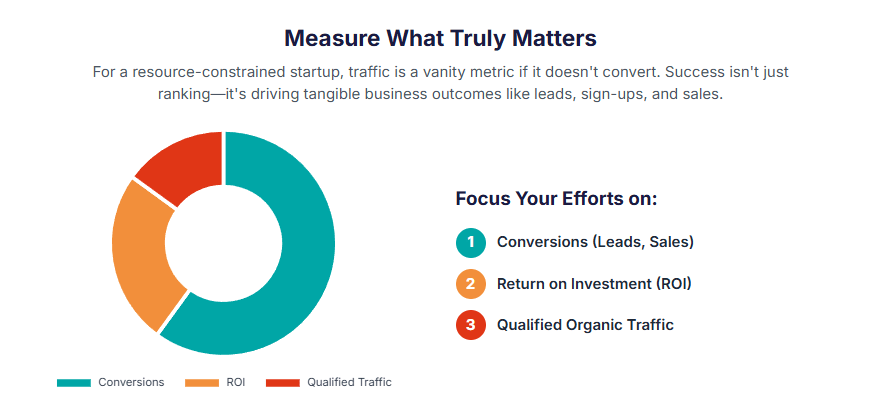
While achieving a Page 1 ranking is often the ultimate aspiration, a truly effective SEO strategy for a startup must extend beyond mere visibility metrics. It is crucial to track performance indicators that directly correlate with business objectives. The focus should shift from solely organic traffic volume to, more importantly, conversions—such as leads generated, sign-ups, demo requests, or direct sales—and the overall Return on Investment (ROI) from organic channels.2 Other vital metrics that provide insights into user engagement and content quality include bounce rate, time on page, and pages per session.14 These metrics offer a holistic view of how effectively SEO efforts are contributing to the business’s bottom line.
To accurately monitor and analyze these performance indicators, startups should utilize a suite of powerful SEO and analytics tools. Google Search Console (GSC) is an indispensable, free resource that provides direct data from Google on how a site performs in search results. It is invaluable for identifying indexing errors, tracking performance by specific search queries and pages, and receiving alerts for any major issues.6
Google Analytics (GA4) is equally essential for understanding detailed user behavior on the website, including traffic sources, engagement metrics, and conversion paths.4 For more comprehensive competitive analysis, keyword rank tracking, site audits, and in-depth backlink analysis, paid tools such as
SEMrush and Ahrefs offer robust dashboards and features.22
For startups, where resources are often limited and the need to demonstrate tangible business impact is immediate 3, simply increasing organic traffic can be a vanity metric if it does not translate into actual conversions.40 Therefore, SEO measurement must be deeply integrated with conversion tracking. By focusing on and attributing metrics like leads, sign-ups, and sales directly to organic search efforts 2, startups can clearly justify their SEO investment and optimize their strategies for genuine business growth, rather than just superficial visibility. This approach also reinforces the effectiveness of targeting high-intent long-tail keywords, as these are designed to attract users who are closer to a conversion point.14 This strategic imperative transforms SEO from a purely technical exercise into a direct revenue driver, which is critical for the survival and scaling of any new business.
Conclusion: Your Path to Page 1 Starts Now!
Achieving significant online visibility and dominating search engine results is not an overnight feat for startups, but it is an incredibly powerful and sustainable long-term investment. By strategically focusing on high-intent, long-tail keywords, crafting valuable and NLP-optimized content that genuinely addresses user needs, building authority through quality backlinks, and ensuring a technically sound website, new businesses can dramatically enhance their online presence and attract their ideal customers. The key to success lies in consistency, a relentless user-first approach, and a commitment to continuous optimization.
Ready to transform your startup’s online presence and climb to the top of the SERPs? At marketingseo.in, our expertise is dedicated to helping businesses like yours navigate the intricate world of SEO. From comprehensive keyword research and strategic content development to meticulous technical audits and robust link-building campaigns, our seasoned team is equipped to get your new business noticed and on its way to dominating Page 1. Contact us today for a personalized consultation and let us help you unlock your full online potential.1
Frequently Asked Questions (FAQs)
What is SEO and how long does it take to see results?
SEO, or Search Engine Optimization, is the systematic process of optimizing a website to enhance its visibility and ranking on search engine results pages (SERPs), ultimately increasing organic (non-paid) traffic.1 While some minor improvements might be observed sooner, most comprehensive SEO campaigns typically require 4 to 6 months to begin showing noticeable results. In highly competitive niches, this timeline can extend further.5 Despite the time investment, SEO is recognized as a long-term strategy that delivers unparalleled return on investment.5
Do I need SEO if I’m a small startup?
Yes, absolutely. SEO is critically important for startups. It represents one of the most cost-effective methods for acquiring new clients without direct per-click costs.41 Furthermore, SEO is instrumental in building long-term brand awareness, enhancing credibility, and fostering trust with your target audience.2 It provides a crucial avenue for new businesses to compete effectively with larger, more established brands by enabling them to target specific niche markets and high-intent users.3
What are the biggest SEO challenges for new businesses?
New businesses commonly face several significant SEO challenges, including limited marketing budgets and resources, intense competition from well-established brands, and complexities associated with technical SEO (such as ensuring fast page speed or resolving indexing issues).3 Additionally, maintaining a consistent schedule for producing high-quality content and building a profile of authoritative backlinks are frequent struggles.3 However, these challenges can be effectively addressed through a focused and strategic approach.14
How do I find the right keywords for my startup?
Finding the right keywords begins with a deep understanding of your target audience’s pain points and their underlying search intent.14 It is advisable to prioritize long-tail, less competitive keywords that indicate high user intent, rather than broad, high-volume terms that are difficult to rank for.12 Utilize professional tools such as Google Keyword Planner, SEMrush, and Ahrefs for comprehensive keyword research. Google Search Console can also provide insights into existing keyword performance. Additionally, examining “People Also Ask” sections on Google and conducting competitor analysis can reveal valuable keyword ideas.14
Can AI-generated content hurt my SEO?
While Artificial Intelligence (AI) tools can certainly assist in content creation, the primary focus for effective SEO remains on producing helpful, original, and well-researched content that demonstrates genuine experience and expertise (E-E-A-T).4 Google’s algorithms are designed to reward high-quality, human-like content that provides real value to users.10 Simply generating content with AI without human oversight, thorough fact-checking, and the addition of unique insights can result in generic, unhelpful material that struggles to rank.8 The optimal approach is to leverage AI as a tool to
enhance human expertise and creativity, rather than allowing it to entirely replace the human element in content development.40
Works cited
- Products | Sark Promotions, accessed on June 14, 2025, https://www.marketingseo.in/digital-products
- 15 SEO Benefits You Need to Know in 2025 – WebFX, accessed on June 14, 2025, https://www.webfx.com/blog/seo/seo-benefits/
- Common Seo Challenges Faced By Startups – FasterCapital, accessed on June 14, 2025, https://fastercapital.com/topics/common-seo-challenges-faced-by-startups.html
- SEO for Small Businesses: Everything You Need to Know – Investopedia, accessed on June 14, 2025, https://www.investopedia.com/seo-for-small-businesses-8584627
- www.rivalmind.com, accessed on June 14, 2025, https://www.rivalmind.com/15-common-seo-questions
- 40+ SEO FAQs You Should Know as a Beginner in 2025 – Outreach Monks, accessed on June 14, 2025, https://outreachmonks.com/seo-faqs/
- Top 75+ SEO Keywords for Startups – Media Search Group, accessed on June 14, 2025, https://www.mediasearchgroup.com/industries/seo-keyword-ideas-for-startups.php
- www.seo.com, accessed on June 14, 2025, https://www.seo.com/blog/seo-challenges/
- 6 Common SEO Issues & How to Solve Them – WordStream, accessed on June 14, 2025, https://www.wordstream.com/blog/seo-issues
- Non-obvious SEO advice for startups – PostHog, accessed on June 14, 2025, https://posthog.com/newsletter/seo-for-startups
- SEO Step-by-Step Tutorial: 3 Essentials for Beginners [+ Next Steps] – HubSpot Blog, accessed on June 14, 2025, https://blog.hubspot.com/marketing/tabid/6307/bid/1436/shortest-tutorial-ever-on-seo-search-engine-optimization.aspx
- Writesonic.com, accessed on June 14, 2025, https://writesonic.com/blog/seo-for-startups#:~:text=Targeting%20high%2Dvolume%20keywords%20like,making%20them%20far%20more%20valuable.
- 10 Best Long Tail Keyword Examples Revealed – Topic Ranker Blog, accessed on June 14, 2025, https://blog.topicranker.com/what-are-long-tail-keywords/
- What is Pain Point SEO? – SEO.AI, accessed on June 14, 2025, https://seo.ai/blog/pain-point-seo
- www.whyoptimize.com, accessed on June 14, 2025, https://www.whyoptimize.com/seo-tips-for-small-businesses
- The Short Story about Long-Tail Keywords for SEO Strategies | Paradux Media Group, accessed on June 14, 2025, https://paraduxmedia.com/long-tail-keywords-for-seo/
- www.bigcommerce.com, accessed on June 14, 2025, https://www.bigcommerce.com/glossary/what-are-long-tail-keywords-how-to-target-in-organic-paid-search/#:~:text=Definition%3A%20Long%20tail%20keywords%20are,a%20niche%20or%20focused%20vertical.
- What are Long-Tail Keywords? And How to Find Them – Conductor, accessed on June 14, 2025, https://www.conductor.com/academy/long-tail-keywords/
- The Ultimate Guide to Long-Tail Keywords for eCommerce Success – LuccaAM, accessed on June 14, 2025, https://www.luccaam.com/long-tail-keywords-for-ecommerce/
- Top Startup Keywords | Free SEO Keyword List – KeySearch, accessed on June 14, 2025, https://www.keysearch.co/top-keywords/startup-keywords
- blog.topicranker.com, accessed on June 14, 2025, https://blog.topicranker.com/what-are-long-tail-keywords/#:~:text=Here%20are%20a%20few%20basic,instead%20of%20%E2%80%9Cdog%20food.%E2%80%9D
- Best SEO Tools for Startups to Grow Traffic and Visibility, accessed on June 14, 2025, https://seo.ai/blog/best-seo-tools-for-startups
- www.networksolutions.com, accessed on June 14, 2025, https://www.networksolutions.com/blog/small-business-seo-guide/#:~:text=Tools%20like%20Google%20Keyword%20Planner,what%20users%20are%20looking%20for.
- The 17 Most Important SEO Tips for Higher Rankings – Backlinko, accessed on June 14, 2025, https://backlinko.com/actionable-seo-tips
- SEO for Small Business: 14 Quick Wins for 2025 – Search Atlas, accessed on June 14, 2025, https://searchatlas.com/blog/seo-for-small-business/
- Pain Point SEO: Finding Solid Topics That Can Drive Revenue – Taylor Scher Consulting, accessed on June 14, 2025, https://www.taylorscherseo.com/saas-seo/pain-point-seo/
- An Ultimate Guide on Semantic SEO (Tips+Tools+Examples) – weDevs, accessed on June 14, 2025, https://wedevs.com/blog/420674/semantic-seo-best-practices/
- Small Business SEO: What to Prioritize? – Gen3 Marketing, accessed on June 14, 2025, https://gen3marketing.com/blog/small-business-seo/
- A Guide for Writing Content for Natural Language Processing (NLP), accessed on June 14, 2025, https://www.jenxwebdesign.com/blog/writing-content-for-nlp
- How To Optimize Your Local Content For NLP – Search Endurance, accessed on June 14, 2025, https://searchendurance.com/how-to-optimize-your-local-content-for-nlp/
- www.hikeseo.co, accessed on June 14, 2025, https://www.hikeseo.co/learn/technical/natural-language-processing-examples#:~:text=To%20boost%20NLP%20scores%2C%20tailor,FAQs%2C%20videos%2C%20or%20tables.
- www.dandymarketing.co.uk, accessed on June 14, 2025, https://www.dandymarketing.co.uk/blog/seo/semantic-seo-for-dummies-how-search-is-changing/#:~:text=Semantic%20SEO%20uses%20natural%20language,with%20how%20semantic%20search%20works.
- What Are Entities In SEO And 6 Ways To Use Them, accessed on June 14, 2025, https://surferseo.com/blog/entity-seo/
- Entity SEO: The Ultimate Guide for Semantic Optimization and Higher Google Rankings, accessed on June 14, 2025, https://seo.tenten.co/en/seo/entity-seo-the-ultimate-guide/
- A Comprehensive Technical SEO Checklist for 2025 – DashThis, accessed on June 14, 2025, https://dashthis.com/blog/technical-seo-checklist/
- SEO FAQ: 30+ Questions To Help You Master SEO, accessed on June 14, 2025, https://www.seo.com/blog/seo-faq/
- Link Building Strategies: The Complete List (2025) – Backlinko, accessed on June 14, 2025, https://backlinko.com/link-building-strategies
- Local SEO: Tips & Strategies to Get Discovered – InMoment, accessed on June 14, 2025, https://inmoment.com/blog/local-seo/
- Travel Website Development Experts | SEO & Booking Growth …, accessed on June 14, 2025, https://www.marketingseo.in/experts-in-travel-website-development
- SEO for Startups: A 10-Step Guide to Boost Your Visibility – Writesonic, accessed on June 14, 2025, https://writesonic.com/blog/seo-for-startups
- Post your startup and ill give you free SEO advice : r/SaaS – Reddit, accessed on June 14, 2025, https://www.reddit.com/r/SaaS/comments/1l9mu8m/post_your_startup_and_ill_give_you_free_seo_advice/
 Best Digital Marketing in India